A recent query made me realise that many people don’t know what types of food
older people should be eating and if they should take supplements or not.
I have previously written two DietDoc topics on Diets for older people -
physiological problems associated with ageing and Nutrition and the elderly -
coping with eating problems, which may help readers to understand what types of
changes occur when we get older and how certain eating problems of old age can
be circumvented.
Healthy seniors
It stands to reason that any person, no matter how young or old he or she may
be, who suffers from any one of the major illnesses (diabetes, obesity, kidney
or heart disease, etc), will have to use a specific diet prescription to treat
the condition. Such individual diet prescriptions should preferably be worked
out and applied under the guidance of a registered dietician, particularly if
the patient suffers from multiple conditions (e.g. diabetes and hypertension and
kidney disease).
Nowadays there are, however, many older people, who are well and active for
their age and do not have any of the major diseases. To answer the question as
to what such individuals should eat, the Dietary Guidelines for Americans - Key
Recommendations for Older Adults (US Dept of Agriculture, 2010), are a good
place to start.
Calculating energy requirements
Mahan and her co-editors (2011) suggest that the Daily Recommended Intakes
(DRIs) for energy for adults can be used to calculate the energy requirement of
older persons, provided an adjustment is made for increasing age.
Example:
The DRI for energy for adults aged 18 years is 12 830 kJ/day (3 067 kcal/day)
for men and 10 060 kJ/day (2 403 kcal/day) for women.
To compensate for the reduced energy requirement due to ageing, these authors
suggest that we subtract 42 kJ/day (10 kcal/day) for men and 29 kJ/day (7
kcal/day) for women for each year of age older than 19 years.
If the person in question is a man of 80 years (i.e. 80-19 = 61 years x 42 kJ
= 2 562 kJ/day), then his approximate energy requirement would be 12 830 minus 2
562 = 10 268 kJ/day (2 452 kcal/day).
If the person in question is a woman aged 82 years (i.e. 82-19 = 63 years x
29 kJ = 1 827 kJ/day), then her approximate energy requirements would be 10 060
minus 1 827 = 8 233 kJ/day (1 967 kcal/day).
In other words, a healthy man aged 80 years would require about 2 500 kJ less
energy every day than when he was 19 years old.
Probiotics
The use of probiotics (“good or beneficial microorganisms”) can benefit
people of all ages, including older people. Try using Bifidoforte or Bifidoflora
(which contain Bifidobacteria), which are recommended specifically for the
treatment of disorders of the colon (large intestine), or Intestiflora (which
contains Lactobacilli and Bifidobacteria), to restore the function of the
intestinal flora after antibiotic treatments. You should be able to purchase
these probiotics at health shops.
Anyone over the age of 65 years, not suffering from a major disease, can
apply these recommendations to ensure balanced nutrition and good health. Older
persons who do have a major condition such as heart disease, hypertension or
diabetes, should consult a registered dietitian for an individual diet
prescription.
A Health Affairs blog, this week is the first ever Health Information Technology.
Sunday, July 29, 2012
Tuesday, June 19, 2012
Treat The Heart Disease By The Healthy Diet
Different people should have different healthy diet.We should make a healthy diet plan for the people with
different illness.Heart disease are highly common among people especially those
that happen to be above 40. Heart disease is a leading reason for death in the
states.
Some useful advice for reducing heart disease risk includes eating a comprehensive diet that includes less saturated fats from red meats, more fresh fruit and veggies, more fish, less sugar, more fiber and for some people, a lesser number of total calories. Then you can certainly make your heart and the rest of your cardiovascular system even healthier by adding more of these foods:
• Olive Oil
• Oats
• Apples
• Almonds
• Red wine
• Whole Grains
• Green leafy vegetables
• Tomatoes
• Soy
• Salmon
From asparagus to sweet potatoes to the robust cabernet -- every mouthful of heart-healthy foods delivers a strong dose of phytonutrients that prevent and repair damage to cells. That's the essence of preventing heart disease.
Indeed, fresh produce give the cornerstone for a heart-healthy diet for the reason that help get rid of free radicals inside the bloodstream, protecting veins. Food in its organic form is regarded as the best. The less processed the better.
The best way to decrease saturated and trans fats in your diet is to restrict the amount of solid fats - butter, margarine and shortening - you add to food when cooking and serving. You can also minimize the quantity of saturated fat in your diet by lowering fat off your meat or choosing lean meats with less than 10 percent fat.
Whole grains, beans and legumes, nuts, fatty fish, and teas are equally important -- offering all kinds of complex heart-protective phytonutrients. To keep the heart healthy, one should
• Have 8-10% of the day's total calories from saturated fat.
• have 30 percent or less of the day's total calories from fat.
• Consume less than 300 milligrams of dietary cholesterol a day.
• Limit sodium intake to 2400 milligrams a day.
As for the Heart disease and the other disease,we should not only eating the pills but also eating healthy food.So we should make a plan for the healthy diet.
Some useful advice for reducing heart disease risk includes eating a comprehensive diet that includes less saturated fats from red meats, more fresh fruit and veggies, more fish, less sugar, more fiber and for some people, a lesser number of total calories. Then you can certainly make your heart and the rest of your cardiovascular system even healthier by adding more of these foods:
• Olive Oil
• Oats
• Apples
• Almonds
• Red wine
• Whole Grains
• Green leafy vegetables
• Tomatoes
• Soy
• Salmon
From asparagus to sweet potatoes to the robust cabernet -- every mouthful of heart-healthy foods delivers a strong dose of phytonutrients that prevent and repair damage to cells. That's the essence of preventing heart disease.
Indeed, fresh produce give the cornerstone for a heart-healthy diet for the reason that help get rid of free radicals inside the bloodstream, protecting veins. Food in its organic form is regarded as the best. The less processed the better.
The best way to decrease saturated and trans fats in your diet is to restrict the amount of solid fats - butter, margarine and shortening - you add to food when cooking and serving. You can also minimize the quantity of saturated fat in your diet by lowering fat off your meat or choosing lean meats with less than 10 percent fat.
Whole grains, beans and legumes, nuts, fatty fish, and teas are equally important -- offering all kinds of complex heart-protective phytonutrients. To keep the heart healthy, one should
• Have 8-10% of the day's total calories from saturated fat.
• have 30 percent or less of the day's total calories from fat.
• Consume less than 300 milligrams of dietary cholesterol a day.
• Limit sodium intake to 2400 milligrams a day.
As for the Heart disease and the other disease,we should not only eating the pills but also eating healthy food.So we should make a plan for the healthy diet.
Tuesday, May 15, 2012
Doing Household Chores Can Help You Burn Some Calories

And losing weight is all about the calories. So why not burn them up while keeping your house clean? Here are some calorie-burning household chores and extra tips to help you use them.
If you don’t want to hit the gym this weekend, stay home and do some chores instead. Doing household chores regularly can help you stay in shape while keeping your house neat and clean.
There are a lot of procedures that can be done to your body to lose weight. There are also different pills and medicines that could help in losing weight but these things cost money. These procedures can be really expensive so looking for alternatives will be a good idea. Looking free ways to lose weight is even better than looking for cheaper ways. This way you will be losing weight without paying for anything. One way to do it would be to do your household chores but how to lose weight doing household chores?
A Little Extra Effort Can Help You Lose Weight
When you do the following chores, you need to make them last a little longer while also maintaining an increased intensity of pace in order to lose weight. In other words, to burn calories while doing your chores, you have to do them with an eye for effort (focus on your muscles), pace (do them a bit more quickly) and duration (for a longer period of time). Putting on headphones or a CD player and blasting your favorite music will energize you and make the activities a lot more enjoyable.
The following estimates of calories burned per chore are based on a person who weighs 150 pounds doing an activity at an increased intensity for 30 minutes. As with any part of your healthy weight loss program, results will vary from person to person.
You don't have to go to the gym, jog or play sports to burn calories. You have plenty of opportunities just doing housework and yard chores.
You probably already know if you want to lose weight how you have to burn more calories each week than you eat. This can be done by a variety of activities, such as working out at the gym, bicycling, swimming, and playing sports, etc.
Unfortunately, buying expensive exercise equipment or investing money in a gym membership isn’t feasible for everyone. What’s more, some people feel they're are too busy to find time for a work out. If you don’t have the time or money to invest in fitness, it’s easy to excuse yourself from exercising.
True, it helps to have a planned activity. But just by working hard in the house and yard you can burn about as many calories as walking on a treadmill for the same amount of time. Yes, all those mundane household chores you do at home daily count in burning a significant amount of calories.
Washing the car. A nice activity that gets you outside for some good Vitamin D from the sun, washing the car can burn 153 calories to help you reach your weight loss goals. Again, your whole body is used as you crouch down to get the tires and stretch fully over the top of the car and the hood. This activity will definitely take you 30 minutes if not more and you will feel the burn by the end of it if you do it vigorously enough. Change the arm that’s holding the sponge to get even activity for each arm and remember to wear sunscreen, if you’re in the sun.
Mowing the lawn. Walking is always recommended for a healthy weight loss program. Pushing the lawnmower around your property gives you this opportunity and can burn 162 calories to get you closer to your goal. You’re getting in a more intense walk than if you just added walking to your program. You also engage your arms and core muscles as you naturally stabilize and coordinate your movements.
Gardening. Not only is gardening an art that can also be a form of organic farming, but it also burns 162 calories to boost your weight loss program. Carrying new plants and flowers to their designated spots gives you some lifting and some cardio. If you do have an organic garden, gathering and carrying food to use in your healthy diet plan is exercise too. Plus, gardening really is a terrific way to commune with nature. Remember; always lift with your legs, not with your back.
Raking leaves. Again, large movements translate into large number of calories burned; shed 171 calories by raking leaves and you just reach your weight loss goal more quickly. Here you get more of that natural Vitamin D from the sun, too.
Scrubbing floors. Really use your muscles when you scrub floors to burn 189 calories and scrub your way to a leaner and more healthy body. Sitting on your heels, take the sponge in both hands and scrub forward, away from your body. Let your rear end come up off your heels. Then scrub back towards you and sit down on your heels again. Do this in different angles away from your body. This movement gives you great cardio and works those tummy muscles too.
Moving around furniture. Ready to redecorate? Moving your couch, chairs, dining room table, bed and other furniture burns 225 calories and gives you a new environment to inspire and encourage you as you lose weight.
Sunday, May 6, 2012
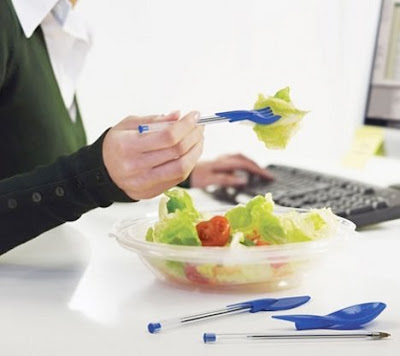
Dining At Your Desk Can Create A Field Day For Bacteria

Lunch rolls around and you grab something quickly without thinking. By afternoon you’re feeling tired and groggy, so you go hit the snack box or vending machine and gulp down a Red Bull.
Welcome to the busy working lifestyle – where the combination of poor nutrition and high stress make for a sick and tired person – and most probably overweight as well.
It's easy to fit healthy eating into your busy lifestyle. These 10 strategies will help you create nutritious, energy-boosting meals in minutes. For those of you trying to eat healthier, one of the biggest places to slip up is at work. There's more temptation to eat out, mindlessly eat, or, not eat at all. To make matters worse, many people never even leave their desks when lunchtime rolls around. If you're trying to change your eating habits this year, here are a few tips to ensure that you have a healthy lunch hour.
1. Stock up on healthy staples every week. Whole-grain breads and cereals, fruits, vegetables, canned beans, low-sodium deli meats, yogurt and low-sodium soup will make meal preparation a snap.
2. While dinner is cooking, prepare lunch for the next day. Toss in a few extra handfuls of veggies or an extra chicken breast to use for sandwiches and salads.
3. At work keep a stash of healthy snack items such as instant oatmeal, baby carrots, yogurt, low-fat frozen burritos, meal-replacement bars, string cheese, low-fat popcorn and fruit canned in its own juice.
4. Always add color to your meal by including a fruit or vegetable.
"Eating at your desk encourages mindless eating, and overeating," says Susan Moores, RD, a spokesperson for the American Dietetic Association. "You're most likely multitasking and not paying attention to the amount of food you're eating."
Lunching at your desk also means that instead of sitting in front of a computer for eight hours a day, you're doing it for nine.
"Eating at your desk also prevents you from getting up and out of your office," Moores tells WebMD. "You need to get the heart pumping and the blood flowing again, and lunch is an important time to do that. If you're sitting at your desk eating, you lose that opportunity."
As if that weren't bad enough, dining at your desk can create a field day for bacteria.
"If you get called away from your desk, and then you have to put off eating for an hour or two, and then you pick at your lunch over the day, you need to be concerned about the temperature of your food and food safety," says Moores.
In other words, your room-temperature chicken salad sandwich that's been sitting out for three hours can easily become a bacteria feeding ground. But wait, it gets worse. (You might want to put that sandwich down now.)
"The desk, in terms of bacteria, is 400 times more dirty than your toilet," says Charles Gerba, PhD, a professor of environmental microbiology at the University of Arizona in Tucson. "People turn their desks into bacteria cafeterias because they eat at them, but they never clean them. The phone is the dirtiest, the desktop is next, and the mouse and the computer follow."
To give your desktop the dirt test, Gerba says, "turn your keyboard over and see how many crumbs fall out. The more of a snowstorm, the dirtier your desk."
Subscribe to:
Posts (Atom)